
Best Educational Gifts for Young Children (2026)
Table of Contents
- What Makes a Gift Truly Educational
- Best Educational Gifts by Age Group
- Developmental Toys for Toddlers That Actually Get Used
- Open-Ended Play Benefits: Why Less Structure Teaches More
- How to Choose Toys for Child Development Without Overspending
- Educational Gifts That Replace Screen Time (Not Just Compete With It)
- Neurodiversity-Inclusive and Eco-Friendly Educational Gifts
- Conclusion
Last Updated: August 30, 2026
What Makes a Gift Truly Educational
Educational gifts actively support a child's cognitive, physical, or social-emotional development through play. The best ones meet a child where they are developmentally, invite curiosity, and grow with them across multiple stages of play.
What separates a genuinely developmental toy from a cleverly marketed one:
- Open-ended design: Can the toy be used in more than one way? Wooden blocks teach spatial reasoning, counting, balance, and imaginative play simultaneously.
- Age-appropriate challenge: The right toy sits just beyond a child's current ability, not so easy it bores, not so hard it frustrates.
- Tactile engagement: Young children learn through their hands. Toys with varied textures, weights, and forms support sensory exploration and fine motor development.
- Durability and safety: A toy that breaks in a week teaches nothing except disappointment. Quality materials mean the toy gets passed down, not discarded.
- Screen-free interaction: Gifts that require a child to do something, not just watch something, build foundational skills that screen-based content rarely can.
According to the American Academy of Pediatrics' guidance on play, play is essential to healthy child development and supports cognitive, physical, social, and emotional well-being.
Best Educational Gifts by Age Group
Age-appropriate selection is the foundation of every good educational gift decision.
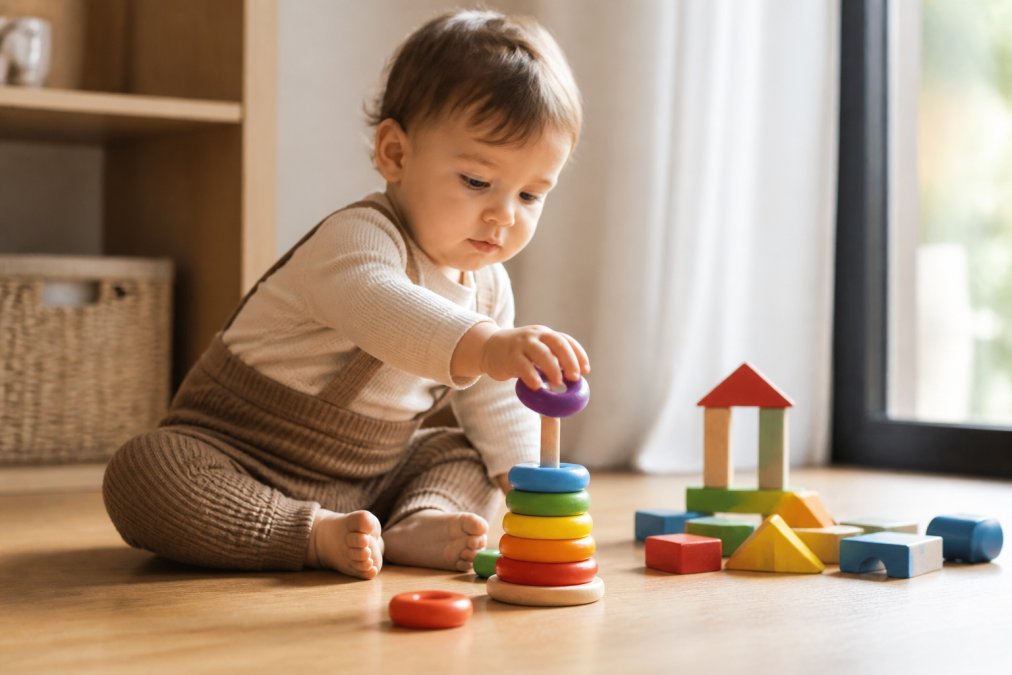
Babies and Infants (0-12 Months): Sensory Exploration First
Infant development centers on sensory exploration and early motor control. Gifts for this age should stimulate multiple senses without overwhelming a nervous system still calibrating to the world.
Strong picks include high-contrast soft books, rattles and teethers with varied textures, soft fabric dolls like those in the Corolle baby collection, and activity gyms with hanging elements. The core principle: stimulate without overwhelming. Fewer, higher-quality objects beat a cluttered toy bin every time.
Toddlers (1-3 Years): Building Foundational Skills
Toddler development explodes during this window. Language, mobility, and social awareness all accelerate simultaneously, and the right educational gifts can support all three at once.
| Gift Type | Developmental Benefit | Best Feature |
|---|---|---|
| Shape sorters | Logical reasoning, fine motor | Problem-solving through trial and error |
| Stacking toys | Spatial reasoning, hand-eye coordination | Self-correcting design |
| Simple puzzles | Cognitive development, persistence | Age-scaled challenge levels |
| Play kitchens | Imaginative play, social-emotional learning | Collaborative and independent play |
| Soft dolls and figures | Nurturing instincts, language development | Open-ended storytelling |
Toddlers learn as much from repetition as from novelty. A toy played with 200 times is more educational than one played with twice.
Preschoolers (3-5 Years): STEM, STEAM, and Creative Expression
Preschool-age children are ready for structured challenges that still leave room for creative expression. Top categories include simple building and construction sets, art supply kits, early science kits with magnets and magnifying glasses, dress-up and role-play sets, and beginner board games.
Play-based learning is the most effective preparation for formal schooling. The National Association for the Education of Young Children's position on play outlines why child-directed play remains central to early childhood education outcomes.
Developmental Toys for Toddlers That Actually Get Used
The most common complaint from parents isn't that a toy was unsafe or poorly made. It's that the toy sat unused after the first week. Developmental toys earn sustained attention when calibrated correctly to a child's current abilities and interests.
Fine Motor Skills and Hand-Eye Coordination
Fine motor development is one of the clearest markers of preschool readiness. Toys that build these skills effectively include lacing and threading toys, peg boards and bead mazes, play dough and modeling clay, tweezers and sorting games, and simple dress-up dolls with buttons or snaps.
Cognitive and Problem-Solving Toys
Cognitive development in early childhood is less about memorizing facts and more about building logical reasoning frameworks. Effective cognitive toys include nesting and stacking sets, cause-and-effect toys, memory matching games, simple jigsaw puzzles, and pattern blocks.
The real difference between a cognitive toy and a passive one is whether the child has to figure something out. If the toy does all the work, the child learns very little.
Open-Ended Play Benefits: Why Less Structure Teaches More
Open-ended play is any play where there is no single correct outcome, no winning condition, and no prescribed sequence of steps. It is the most powerful educational structure available to young children.
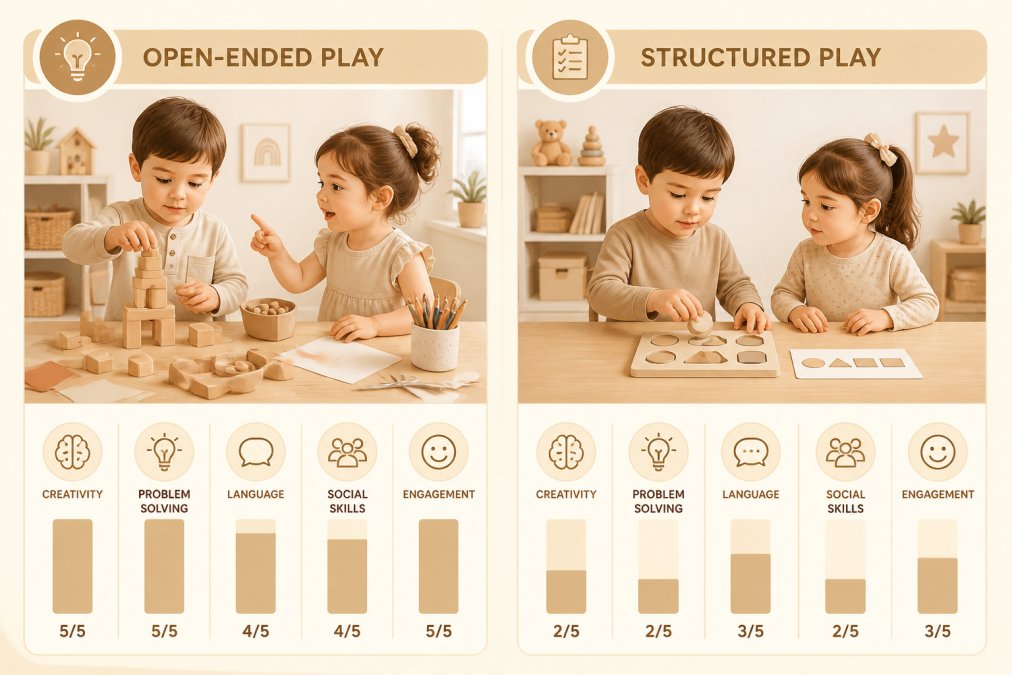
Open-ended play builds skills that structured activities cannot replicate. When a child decides what blocks will become, they exercise executive function, creative expression, and problem-solving simultaneously. When they play alongside another child, they develop collaborative play skills and social-emotional learning.
The open-ended play benefits that matter most for development include sustained attention, intrinsic motivation, flexible thinking, and language development. The best open-ended educational gifts are deceptively simple: wooden blocks, loose parts, fabric dolls, art materials, and natural objects.
How to Choose Toys for Child Development Without Overspending
Choosing toys for child development doesn't require a large budget. It requires intentionality. Many of the most effective developmental toys are simple, durable objects that cost less than flashy electronic alternatives and outlast them by years.
Montessori-Inspired Principles to Guide Your Pick
Montessori-inspired learning tools share design principles that translate directly into better purchasing decisions:
- Real over pretend: Tools that mimic real objects teach practical skills alongside fine motor development.
- Self-correcting design: Toys that show children when they've made a mistake build independence and logical reasoning.
- Beauty and quality: Children respect and engage more with materials that are well-made and aesthetically pleasing.
- Isolation of concept: The best toys teach one concept at a time clearly.
- Child-led pacing: Toys should invite exploration at the child's own speed.
Safety Standards and Non-Toxic Materials
Safety is non-negotiable. The Consumer Product Safety Commission's toy safety guidelines set baseline requirements for toys sold in the United States. Beyond regulatory minimums, look for non-toxic paint and finishes, solid wood construction, ASTM F963 certification, and age-appropriate part sizes.
High-quality boutique toys often exceed these standards by design, not just compliance.
Educational Gifts That Replace Screen Time (Not Just Compete With It)
Most educational toys compete with screens rather than replace them. The toys that genuinely displace screen time create a feedback loop screens can't replicate. A child building a tower gets tactile feedback, visual feedback, and the physical experience of success or failure.
Gifts that consistently pull children away from screens include building and construction sets, art supplies with open materials, dolls with rich accessory worlds like Corolle figures, sensory bins and exploration kits, and cooperative board games.
The key insight: the best screen-time replacement isn't the most educational toy. It's the most engaging one. Educational value follows naturally when a child is genuinely absorbed.
Neurodiversity-Inclusive and Eco-Friendly Educational Gifts
The most thoughtful educational gifts work across a range of learning styles, sensory profiles, and developmental timelines.
Toys That Work for a Range of Sensory and Learning Needs
Neurodiversity-inclusive toy design recognizes that sensory exploration looks different for every child. Gifts that work well across sensory and learning profiles include weighted or textured sensory toys, simple low-stimulation designs, cause-and-effect toys with predictable outcomes, fidget and manipulation tools, and open-ended materials without a "right" answer.
When in doubt, choose toys with fewer moving parts and more material variety.
Sustainable Materials and Budget-Friendly DIY Alternatives
Toys made from natural, responsibly sourced materials tend to be more durable, safer, and more pleasant to handle than plastic alternatives. As documented in the EPA's guidance on sustainable consumer products, reducing single-use plastic in consumer goods is one of the highest-impact individual choices families can make.
Budget-friendly alternatives that don't sacrifice educational value include DIY sensory bins, loose parts collections, homemade play dough, cardboard construction, and nature exploration kits.
| Gift Category | Best For | Eco-Friendly Option | Neurodiversity Consideration |
|---|---|---|---|
| Building sets | Spatial reasoning, STEM | FSC-certified wood blocks | Low-stimulation, predictable |
| Sensory toys | Tactile learning, self-regulation | Natural rubber, organic cotton | Adjustable input levels |
| Art supplies | Creative expression, fine motor | Non-toxic, water-based | Open-ended, no wrong answers |
| Dolls and figures | Imaginative play, nurturing | Natural fiber soft dolls | Soft textures, simple design |
| Puzzles | Cognitive development | Sustainably sourced wood | Self-correcting, low frustration |
Finding the right educational gifts for young children is genuinely hard when every toy on the market promises developmental benefits. The honest shortcut is to focus on three things: open-ended design, age-appropriate challenge, and durable, non-toxic materials. Charlie Anne's Closet was built around exactly this standard, curating Corolle dolls, sensory toys, and imaginative play gifts that families return to again and again. Browse the collection and subscribe to save 10% on your first order, because the best gift is one that earns its place in the playroom for years.
Frequently Asked Questions
What are the best educational toys for toddlers to encourage development?
The most effective developmental toys for toddlers combine tactile learning with open-ended play. Stacking rings, shape sorters, simple puzzles, and building blocks all support fine motor skills, spatial reasoning, and cognitive development without requiring a screen. Look for toys made from non-toxic materials that meet ASTM F963 safety standards. Age-appropriate challenge matters most: a toy that's slightly harder than a child's current ability builds problem-solving skills without causing frustration.
How do I choose an educational gift that a child will actually use?
Match the toy to the child's developmental stage, not just their age. A gift that supports where they are right now, whether that's sensory exploration, imaginative play, or early STEM thinking, gets used far more than one that's too advanced. Prioritize open-ended toys with no single 'right answer,' since children return to them repeatedly. Durable construction and non-toxic materials are also worth checking before you buy, especially for children under 3.
What are the benefits of open-ended play for young children?
Open-ended play builds critical thinking, creative expression, and social-emotional learning because children direct the experience themselves. Unlike single-use toys with one outcome, open-ended toys like blocks, dolls, and art supplies grow with a child's imagination. Research in early childhood education consistently links this type of play to stronger preschool readiness, better collaborative play skills, and improved logical reasoning. It also keeps children engaged longer, which is why these toys tend to stay off the shelf.
Are there specific educational gifts that help with fine motor skills?
Yes. Threading beads, lacing cards, pegboards, play dough sets, and simple construction sets all build fine motor skills and hand-eye coordination in young children. For toddlers under 3, chunky puzzles and large building pieces work well since small parts pose a choking hazard under that age. For preschoolers, tools like child-safe scissors, stamp sets, and watercolor kits add creative expression while continuing to develop the hand strength needed for writing.
What makes a toy truly educational versus just entertaining?
An educational toy builds at least one measurable skill: fine motor control, spatial reasoning, logical reasoning, language, or social-emotional learning. Entertainment alone isn't the goal, the best educational gifts do both. Watch for toys that require a child to make decisions, solve problems, or create something original. Toys that adults have to set up, narrate, or manage constantly often signal passive engagement. Truly educational toys put the child in control of the outcome.
This article was written using GrandRanker
